
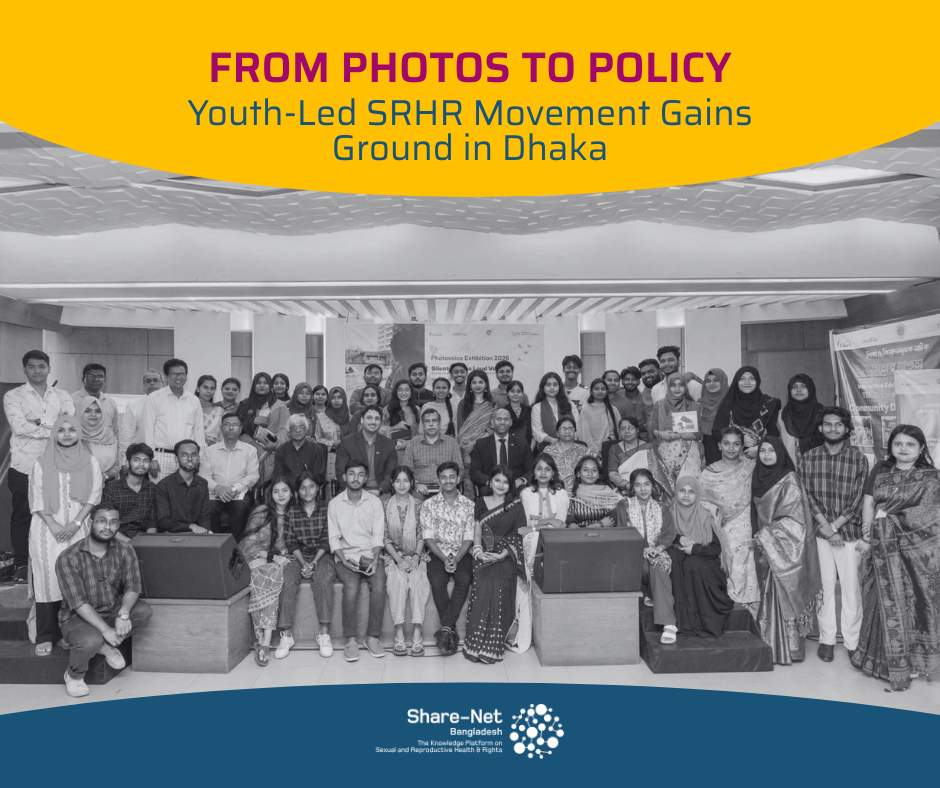
From Photos to Policy: Youth-Led SRHR Movement Gains Ground in Dhaka
In a city where millions live on the margins, stories often go unheard. But sometimes, a photograph can say what policy papers cannot. At the “Silent Frames, Loud Voices” photovoice exhibition in Dhaka, young people turned everyday realities into powerful narratives—forcing a conversation on sexual and reproductive health and rights (SRHR) that Bangladesh can no longer afford to ignore.
The event, attended by Canada’s High Commissioner Ajit Singh alongside senior government officials, signals a growing alignment between youth voices, policymakers, and international partners. At its core lies the প্রজনন স্বাস্থ্য বন্ধু – Improving SRHR in Dhaka initiative, a $12.2 million programme funded by Canada and implemented by HealthBridge Foundation of Canada and Ipas Bangladesh.
The exhibition showcased 16 visual stories captured by youth volunteers. These images documented the lived experiences of women and adolescents in low-income communities, where access to sexual health, reproductive health, and sexual rights remains uneven. The inclusion of edutainment drama further bridges the gap between awareness and engagement, turning complex SRHR issues into relatable community dialogue.
“Silent Frames, Loud Voices” is more than a creative exercise. It reflects a strategic shift in SRHR programming—from top-down messaging to community-led storytelling. Over 1,000 youth volunteers have been trained under the project, acting as peer educators and advocates. Their work has already connected communities to 154 health facilities across Dhaka, contributing to services reaching more than 365,000 women and adolescent girls.
This progress is significant in a country where challenges persist. According to the latest Bangladesh Demographic and Health Survey (BDHS), nearly 28% of married adolescent girls still face unmet needs for family planning. Meanwhile, urban slums continue to struggle with limited access to quality reproductive health services. Against this backdrop, youth-led initiatives offer a practical and scalable solution.
What sets this project apart is its integration of storytelling with service delivery. Photovoice—a participatory method—empowers individuals to document their realities while influencing decision-makers. It transforms beneficiaries into contributors, shifting the narrative from vulnerability to agency.
However, the initiative also raises critical questions. Can such localised successes be scaled nationwide? Will institutional systems absorb and sustain youth-driven models beyond donor funding? And how can policymakers ensure that community voices translate into long-term structural reform?
Canada’s continued commitment to “inclusive, rights-based, and people-centred health outcomes” highlights the importance of global partnerships. Yet, the sustainability of SRHR progress in Bangladesh will depend on how effectively these collaborations are embedded within national systems.
As the exhibition suggests, the future of SRHR in Bangladesh may not lie solely in clinics or campaigns but in the hands of young people who are documenting, questioning, and reshaping the narrative. When their voices are amplified, silence is no longer an option.